


Why Do Whales Breach? Jacques Cousteau Called It a “Physical Exclamation Point”
Few sights in nature are as unforgettable as a humpback whale launching its massive body out of the ocean and crashing back onto the surface. It is called a breach — and it is one of the most spectacular behaviors we see while whale watching along the Jersey Shore.
But why do whales breach?
The fascinating answer is that scientists still do not know for certain. Breaching may serve several different purposes depending on what the whale is doing, who is nearby, and conditions in the ocean.
What Is a Whale Breach?
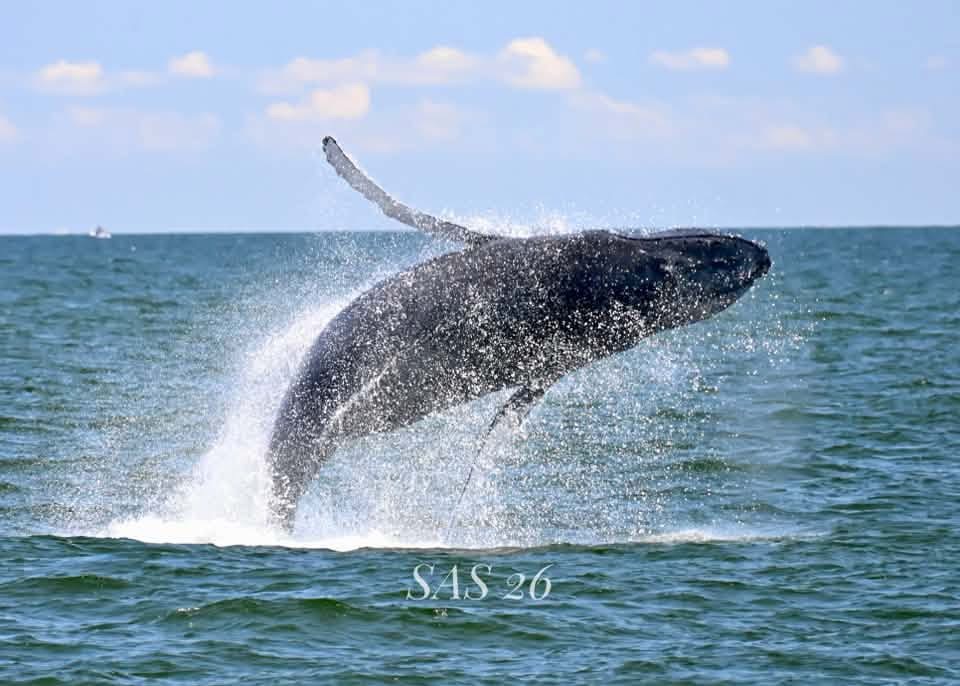
A breach occurs when a whale accelerates toward the surface and propels a significant portion of its body out of the water before falling back into the ocean.
Humpback whales are especially famous for this behavior. A full-grown humpback can weigh tens of thousands of pounds, which makes watching one launch itself almost completely clear of the water even more remarkable.
Jacques Cousteau Had a Wonderful Way of Describing It
Legendary ocean explorer Jacques-Yves Cousteau and author Yves Paccalet discussed whale breaching in their book Whales.
Cousteau suggested that a breach could reinforce a whale’s other visual or acoustic signals — describing it memorably as a kind of “physical exclamation point.”
Imagine a whale communicating and then adding an enormous splash at the end of the message — almost like putting an exclamation point at the end of a sentence.
Decades later, that idea remains remarkably consistent with what scientists continue to learn about humpback whale communication.
Breaching May Be a Form of Communication
One of the leading explanations is that breaching helps whales communicate with one another.
When a large humpback crashes onto the surface, it creates an enormous amount of sound both above and below the water. Those vibrations can travel through the ocean and potentially be detected by other whales some distance away.
Researchers studying humpback whales have found that whales use both vocal sounds and surface-generated sounds — including breaching and pectoral-fin slapping — as part of their communication repertoire.
Interestingly, research has also shown that humpbacks may rely more heavily on these spectacular surface behaviors when wind and background ocean noise increase. In noisy conditions, making a huge splash may sometimes be an effective way of getting another whale’s attention.
Are Whales Breaching Because They Are Playing?
Possibly.
Whales sometimes breach repeatedly, particularly younger humpbacks. Play and social interaction are among the possible explanations scientists consider.
Anyone who spends enough time observing humpbacks quickly learns that the same behavior does not necessarily mean the same thing every time.
Could Breaching Help Remove Barnacles or Parasites?
Another theory is that the tremendous impact of hitting the water may help loosen dead skin, parasites, or organisms attached to a whale’s body.
Humpback whales commonly carry barnacles and other organisms on their skin, so physical maintenance may sometimes play a role in breaching and other vigorous surface behaviors.
Sometimes One Whale Starts — and Others Join In
One of the most exciting things we occasionally observe is a change in the behavior of several whales at once.
A whale may breach, another whale may begin slapping its enormous pectoral fins, or whales nearby may suddenly become much more active at the surface.
Scientists continue studying how these behaviors relate to group formation, separation, courtship, feeding, communication and social interaction.
Why Would a Whale Spend So Much Energy Breaching?
That may be the most intriguing question of all.
Moving a huge whale rapidly enough to clear the surface requires substantial effort. When a humpback breaches repeatedly, it is deliberately investing energy in that behavior.
That is one reason scientists believe breaching probably serves meaningful biological or social functions rather than simply being a random movement.
So Why Do Humpback Whales Breach?
The best answer today is: probably for more than one reason.
Breaching may involve:
- Communication with other whales
- Social interaction
- Play
- Courtship or competition
- Removing loose skin or parasites
- Responding to other whales nearby
What scientists cannot yet do is look at every breach and confidently say exactly why that particular whale did it.
Cousteau’s “Exclamation Point” Is Still a Great Way to Think About It
Jacques Cousteau spent much of his life helping people understand that the ocean is filled with sophisticated animals whose lives we are only beginning to understand.
His description of a whale breach as a “physical exclamation point” captures something every whale watcher immediately understands.
You can hear a whale breathe. You can watch its tail disappear beneath the surface. You may see it slap a 15-foot pectoral fin against the water.
But when a humpback launches its entire body into the air and crashes back into the Atlantic Ocean, it certainly feels like the whale has added an exclamation point.
See Humpback Whales Along the Jersey Shore
Humpback whales regularly visit the waters off New Jersey to feed, and every trip is different. On some days we watch whales traveling or feeding quietly. On another day, without warning, a whale may suddenly breach.
That unpredictability is part of what makes seeing these animals in the wild so extraordinary.
Join Jersey Shore Whale Watch aboard the Jersey Girl and experience New Jersey’s marine wildlife in its natural environment.
Learn more and book your whale watching trip at JerseyShoreWhaleWatch.com.